
Written by Paul Lane

The Word
20 “But when you see Jerusalem surrounded by armies, then know that its desolation has come near. 21 Then let those who are in Judea flee to the mountains, and let those who are inside the city depart, and let not those who are out in the country enter it, 22 for these are days of vengeance, to fulfill all that is written. 23 Alas for women who are pregnant and for those who are nursing infants in those days! For there will be great distress upon the earth and wrath against this people. 24 They will fall by the edge of the sword and be led captive among all nations, and Jerusalem will be trampled underfoot by the Gentiles, until the times of the Gentiles are fulfilled.
-Luke 21:20-24 (ESV)
2 But he answered them, “You see all these, do you not? Truly, I say to you, there will not be left here one stone upon another that will not be thrown down.”
Matthew 24:2
Reflection
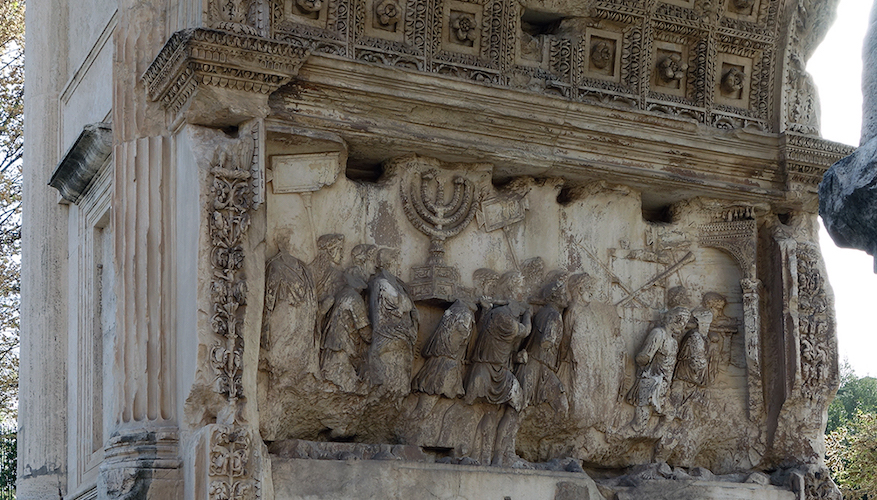
In Rome, near the Colosseum, there is an arch built to Titus, son of Vespasian. After the death of Nero in 68 AD, Vespasian was named Emperor and at that time his son Titus was a leader in the roman army, serving in the region of Judea. During his service, Titus had many dealings with the Jewish people and the newly emerging Christian communities. For most Romans, they were just starting to learn the difference between a Jew and a Christian. (We were still writing the New Testament, so word was still getting out to the world).
Judea was a region full of unrest, and Jerusalem was in the throws of a civil war between several Jewish factions. The state of affairs in Jerusalem was a concern for the Roman throne, so Titus took up arms and besieged the city. When the Roman armies showed up, the Christian impulse was to flee, as Christ had warned in Luke 21:21. However, the Jewish impulse was to stay within the protection of the city walls.
As the Roman legions surrounded Jerusalem, the factions inside continued to fight each other initially, but eventually turned to fight the Romans. The fighting was fierce and lasted for months. As a side note, according to R. C. Sproul, the Romans would loft huge multi ton stones in the air to break down the walls and to kill people inside. To avoid being crushed by a stone, the watchmen on the walls would yell a warning which is sometimes translated “the stone cometh,” but was often pronounced as “the son cometh.”
Eventually, the Roman army won out, crushed the city and destroyed the temple. It is said that the destruction was so complete that one stone did not lay upon another, thus fulfilling Jesus words in Matthew 24:2. Before destroying the temple, Titus performed all manner of indecencies and denouncements of the Jewish temple; from spreading the blood of pigs to placing a statue of Zeus on the alter, Titus held nothing back. He also ordered his men to take all the valuables from the temple. So, all of the riches in the city, particularly the temple, were taken back to Rome.
Now here’s an interesting point that I got from an inside connection. My wife’s brother-in-law, Stefano Pace, was a tour guide in Rome for many years. During one trip there he explained to me that the riches that were taken from the temple were used to finance the building of the Colosseum, a place where a number of Christians would be martyred. Also, Stefano loved to point out that the majority of Christians killed by lions were killed in the Circus Maximus, of Ben-Hur fame, because it could accommodate larger crowds.

Application
One reason Stefano liked to point out the source of the finances for the Colosseum is that there were people, in modern day, saying that Rome did not destroy the Jewish temple. But if you look on the inside of the Arch of Titus, you can see a relief (carving) of the roman army returning from Judea. If you look closely, you will see that there is a Jewish Menorah being carried. One could say that the evidence of the destruction of the temple is literally written in stone. This is how faithful the words of Jesus are. You can trust that what he says is true.
Prayer
Dear Lord, the story of the destruction of the temple puts fear in my heart. It shows that great and terrible days can really happen. So, I draw nearer to You, in hopes that I might learn more of your ways, and do that which You have prescribed for me. Please give me the grace and wisdom to follow Your lead. Amen.

 City Life Starter
Leave a Reply