
I. Word:
Genesis 1:1-2; 1:26
1 In the beginning, God created the heavens and the earth. 2 The earth was without form and void, and darkness was over the face of the deep. And the Spirit of God was hovering over the face of the waters.
26 Then God said, “Let us make man in our image, after our likeness. And let them have dominion over the fish of the sea and over the birds of the heavens and over the livestock and over all the earth and over every creeping thing that creeps on the earth.”
Mark 1:9-11
9 In those days Jesus came from Nazareth of Galilee and was baptized by John in the Jordan. 10 And when he came up out of the water, immediately he saw the heavens being torn open and the Spirit descending on him like a dove. 11 And a voice came from heaven, “You are my beloved Son; with you I am well pleased.”
Matthew 28:19
19 Go therefore and make disciples of all nations, baptizing them in the name of the Father and of the Son and of the Holy Spirit,

As we continue on our journey of knowing and understanding the Holy Spirit, let’s continue to discuss who He is in relation to the Father and Son. In the book of Genesis, we read above, we see the Spirit hovering over the waters and the following verse (not shown) has the Father speaking as the Word (Jesus) brings to life all things into existence. Verse 26 God says, “Let us make man in our image, after our likeness.” Focusing on the word “our” we can make certain conclusions. One conclusion is that it can look almost like we are worshiping three different gods. Spolier alert: that is not the trinity. That would be polytheism (the worship of mulitple gods) which is not accurate with the scriptures. So, what is the trinity exactly?
In his book Because God is Real:Sixteen Questions, One Answer by Peter Kreeft he states, “The doctrine of the Trinity does not say there is one God and three Gods, or that God is one Person and three Persons, or that God has one nature and three natures. Those would indeed be self-contradictory ideas. But the doctrine of the Trinity says that there is only one God and only one divine nature but that this one God exists in three Persons. That is a great mystery, but it is not a logical self-contradiction.”
Look at the following set of propositions taken from the Athanasian Creed:
1) The Father is God
2) The Son is God
3) The Holy Spirit is God
4) There are not three Gods but one God
These propositions are often pictorially represented in church windows and theology texts by this diagram:
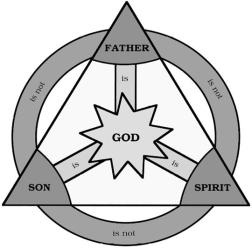
It’s hard to grasp this concept with a static picture or statement alone. Often analogies are used to help comprehend the idea of the trinity, but no one analagy can fully encompass this idea of God.
As a musician myself I personally enjoy the musical analogy proposed by theologian Jeremy S. Begbie: A musical chord is essentially composed of three different notes (to be a chord all three notes must be present), namely the first, third and fifth notes of a given musical scale. For example, the chord of C major is composed of the notes C (the root of the chord), E (the third from the root) and G (the fifth from the root). Each individual note is ‘a sound’, and all three notes played together are likewise ‘a sound’. Hence a chord is essentially three sounds in one sound, or one sound essentially composed of three different sounds (each of which has an individual identity as well as a corporate identity). By analogy, God is three divine persons in one divine personal being, or one divine personal being essentially composed of three divine persons. Moreover, when middle C (the root of the chord) is played it ‘fills’ the entire ‘heard space’. When the E above middle C is played at the same time, that second note simultaneously ‘fills’ the whole of the ‘heard space’; yet one can still hear both notes distinctly. When the G above middle C is added as well, a complete chord exists; one sound composed of three distinct sounds:
“What could be more apt than to speak of the Trinity as a three-note-resonance of life, mutually indwelling, without mutual exclusion and yet without merger, each occupying the same ‘space,’ yet recognizably and irreducibly distinct, mutually enhancing and establishing each other?”
In John 12:28 God the Father can say ‘I’ , the Son can say ‘I’ in John 17:4 and the Spirit can say ‘I’ in Acts 13:2. The Father says ‘Thou’ to the Son in Mark 1:11), the Son says ‘Thou’ to the Father in John 17:2 and the Father and the Son use the words ‘He’ and ‘Him’ in reference to the Spirit in John 14:26; 15:26. Additionally, the Father loves the Son according to John 3:35, the Son loves the Father according to John 14:31 and the Spirit testifies to the Son in John 15:26.
Paul prayed for the Corinthians that: “the grace of the Lord Jesus Christ, the love of God, and the fellowship of the Holy Spirit be with you all” (2 Corinthians 13:14). God says of himself He is one in Deut. 6:4 and Jesus prays that we the Church would be one as He and the Father are one in John 17:20-21.
So what does this say about God? Many things actually, endless things. We could and will be forever amazed as we discuss His glorious ways and goodness for all eternity. He is not to just simply be boxed in or figured out, but rather to be explored, sought and continuously be in awe of.
He shows us what love truly is as He fulfills this selfless love in and of himself. He did not make us because he needs our love, but rather to express and have us join in this love union He is the author and maker of. We get to join Him in this relational dance of His as we are made in His image. After all, we are spirit, soul and body and although our Spirit has been reborn (John 3:3) through the work of Christ, our soul is being saved and our body is decaying (2 Cor. 4:16), one day we will see perfectly (1 Cor. 13:12) with a new body (1 Cor. 15:50-52), completely led by our spirit into worship of our great God. We too, made in His image, are complicated and multifacted and in order to truly know ourselves we must have relational and thoughtful pursuit of God in all his wonderous ways.
Therefore, the understanding of the trinity is not something that should be left to the theologians, but all Christians should have at least some grasp of this idea and a general understanding of what the trinity is and is not. As it is commanded to us to love God with all of our heart, soul, MIND and strength (Deut. 6:4-5), let us all take special consideration of the mind. We easily draw ourselves into memorizing great deals of information about sports, science, or the latest fashion trends. I pray the wonder and pursuit of God becomes our greatest obsession as it should be practically and not just out of lip service.
Resources For Further Study:
For further study on the trinity I love Dr. William Lane Craig who is considered to be one of if not the greatest Christian apologist living today. Click here
Audio (Part 1) of the Doctrin of the Trinity by William Lane Craig. Click here
4 Minute Video clip of William Lane Craig on the trinity. Click here
Ravi Zacharias clip explaining the trinity. Click here
 City Life Starter
Leave a Reply